

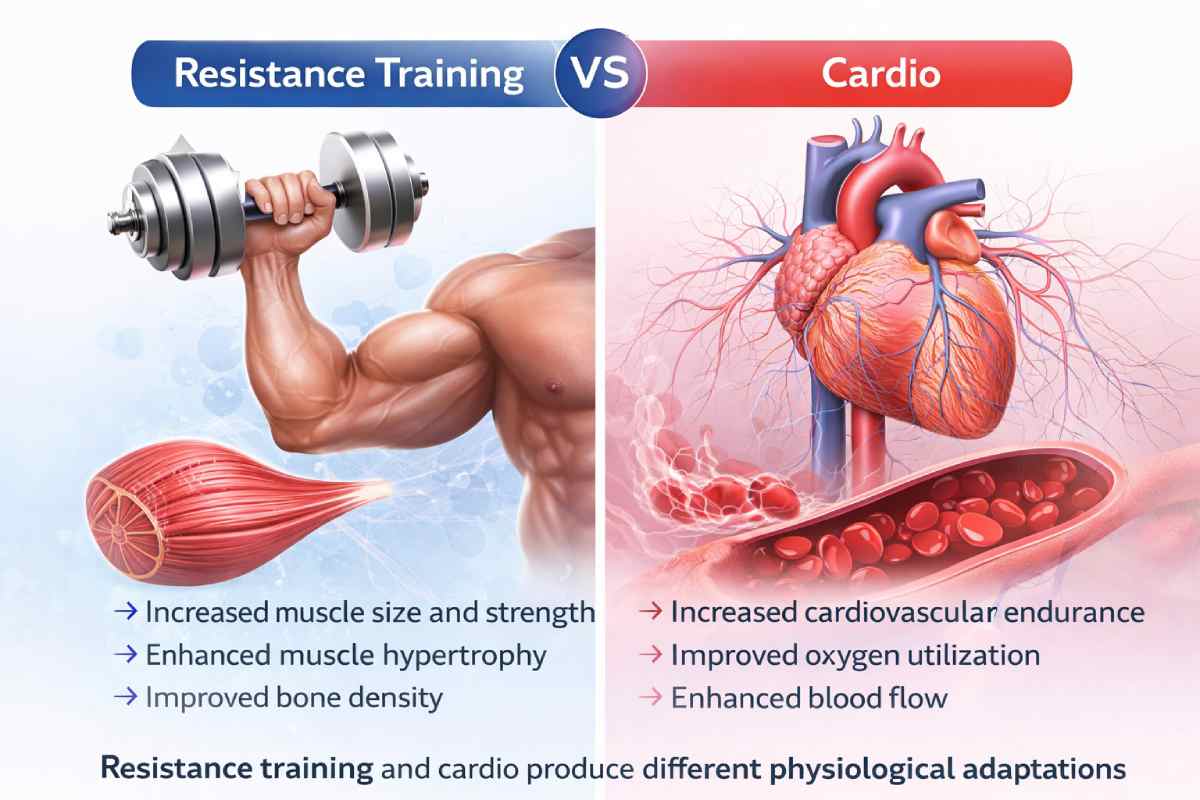
Why does Weight Training Improves Strength more than cardiorespiratory fitness?
The short answer:
Because the body adapts specifically to the type of stress placed on it.
Resistance training stresses muscles directly.
Cardio stresses the oxygen-delivery system.
So each produces different improvements.
Understanding this difference helps you:
Let’s explore this step by step—from basic explanation to advanced physiology.
| Feature | Weight Training | Cardio Training |
| Primary Target | Skeletal muscles | Heart + lungs |
| Main Adaptation | Strength | Endurance |
| Fiber Recruitment | Fast-twitch fibers | Slow-twitch fibers |
| Energy System | Anaerobic | Aerobic |
| Structural Change | Muscle hypertrophy | Mitochondrial growth |
| Performance Metric | 1RM strength | VO₂ max |
| Oxygen Dependence | Low | High |
Before comparing adaptations, we must define both terms clearly.
What Is Muscular Strength?
Muscular strength is the maximum force a muscle can produce in a single effort.
Example:
It’s commonly measured using one-rep maximum (1RM).
Cardiorespiratory fitness refers to how efficiently the body:
It is measured using VO₂ max, the body’s oxygen-use capacity.
So strength = force production
Cardiorespiratory fitness = endurance capacity
Different systems → different adaptations.
This is the most important concept.
Your body adapts specifically to the stress you apply.
Example:
Lift heavy → muscles adapt
Run long distances → heart adapts
This is called the SAID principle.
It explains why weight training improves muscular strength more than cardiorespiratory fitness.
Exercise physiology research confirms the Specific Adaptation to Imposed Demands (SAID) principle, meaning the body adapts directly to the type of stress placed on muscles and energy systems during training. Principles of exercise adaptation explained
Resistance training triggers three major adaptations.
Weight training causes microscopic muscle fiber damage.
During repair:
muscle fibers grow thicker and stronger
This process is called hypertrophy.
Hypertrophy increases:
Result:
greater strength output
Early strength gains occur before muscles visibly grow.
Why?
Because the nervous system becomes more efficient.
Changes include:
Resistance training increases motor-unit activation significantly.
This is why beginners gain strength quickly in the first 4–6 weeks.
Weight training activates:
Type II muscle fibers
These fibers produce:
high force
short duration effort
Cardio mainly activates slow-twitch fibers instead.
So resistance training targets the fibers responsible for strength.
Aerobic exercise produces different adaptations.
Instead of enlarging muscle fibers, cardio improves oxygen transport systems.
Key adaptations include:
Endurance training increases mitochondrial number and energy efficiency inside muscle cells.
These changes improve stamina—not maximum force.
Endurance training increases mitochondrial density and cardiovascular efficiency, which enhances oxygen delivery and utilization rather than maximal force production. Scientific review of endurance vs strength adaptations
The body uses three energy systems:
| Energy System | Used During |
| ATP-PC | Heavy lifting |
| Glycolytic | Sprinting |
| Oxidative | Cardio |
Weight training primarily uses:
ATP-PC system
Cardio uses:
oxidative system
Since strength depends on rapid energy release, resistance training trains the correct energy pathway.
Mechanical tension is the strongest stimulus for muscle growth.
Weight training creates:
Cardio does not produce enough mechanical overload.
Without overload:
muscle hypertrophy remains limited.
Resistance training stimulates anabolic hormones such as:
These support:
muscle repair
protein synthesis
strength gains
Cardio produces different hormonal responses focused on endurance metabolism instead.
Aerobic exercise changes the heart structurally.
It increases:
stroke volume
cardiac output
oxygen delivery
Improvement in stroke volume is the main driver of VO₂ max increases.
Resistance training produces different heart adaptations.
These support short-burst effort—not endurance.
Weight training improves strength more because:
it makes muscles thicker and stronger
Cardio improves endurance because:
it makes heart and lungs stronger
Resistance training:
Cardio training:
Different targets → different outcomes
Resistance training increases:
myofibrillar protein synthesis
neuromuscular efficiency
type II fiber hypertrophy
Cardio increases:
mitochondrial biogenesis
capillarization
oxidative enzyme activity
Thus resistance training improves:
maximal voluntary contraction force
While cardio improves:
oxygen extraction capacity
Common myth:
Cardio builds strength
Reality:
Cardio builds endurance
Another myth:
Weight training improves heart fitness equally
Reality:
It improves heart performance differently—not maximally.
Balanced training is ideal.
Yes—but only slightly.
Resistance training can:
increase anaerobic capacity
improve oxygen efficiency modestly
However:
it does not significantly raise VO₂ max in trained individuals.
Consider two athletes:
Weightlifter
Can lift heavy loads
Fatigues quickly during running
Marathon runner
Runs long distances
Cannot lift maximal loads
Both are fit.
But fitness types differ.
There are two main fiber types.
| Fiber Type | Function |
| Type I | Endurance |
| Type II | Strength |
Resistance training increases:
Type II activation
Cardio increases:
Type I efficiency
So strength improves mainly with resistance exercise.
Weight training increases:
myofibril density
fiber cross-sectional area
tendon strength
Resistance training strengthens connective tissues too.
Cardio mainly improves:
metabolic efficiency
Not structural force capacity.
Cardio helps strength when:
someone is sedentary
Early improvements occur because:
any activity improves baseline conditioning
Later:
strength gains plateau without resistance training.
Concurrent Training: The Best Strategy for Overall Health
Research shows combining:
aerobic training
resistance training
improves both strength and cardiorespiratory fitness more effectively than cardio alone.
This is why doctors recommend mixed programs.
This guide helps:
medical students
fitness learners
rehabilitation patients
beginners starting strength training
people confused about exercise differences
This article is not intended as:
a personalized training plan
a replacement for physiotherapy guidance
a substitute for cardiac rehabilitation programs
Consult a physician if you have:
heart disease
joint injury
chronic illness
Only doing cardio
Result:
minimal strength improvement
Lifting too light
Insufficient overload prevents hypertrophy.
Skipping recovery
Muscles grow during recovery—not exercise.
Avoiding progressive overload
Strength requires increasing resistance gradually.
When to Worry (Medical Guidance Section)
Consult a healthcare professional before starting weight training if you have:
uncontrolled hypertension
recent surgery
cardiac disease
severe arthritis
chronic respiratory illness
Stop exercise immediately if you experience:
chest pain
dizziness
breathlessness beyond normal exertion
irregular heartbeat
These symptoms require evaluation.
| Goal | Best Exercise Type |
| Lift heavier objects | Resistance training |
| Improve stamina | Cardio |
| Reduce fatigue walking upstairs | Cardio |
| Prevent sarcopenia | Resistance training |
| Improve daily function | Both |
Why does weight training improve muscular strength more than cardiorespiratory fitness?
Because resistance exercise creates mechanical overload that increases muscle size and neural activation, while cardio mainly improves oxygen-delivery efficiency.
Can cardio increase muscle strength?
Only slightly and mainly in beginners.
Does weight training improve heart health?
Yes—but less than aerobic exercise for endurance capacity.
Which is better overall: cardio or weight training?
Both are necessary for complete health.
How often should adults do strength training?
At least twice weekly alongside aerobic activity.
Understanding why weight training improves muscular strength more than cardiorespiratory fitness becomes clear when you look at how the body adapts to exercise stress. Resistance training stimulates muscle hypertrophy, neural efficiency, and fast-twitch fiber activation, while aerobic exercise improves oxygen delivery and endurance capacity. For optimal long-term health, combining both training styles produces the strongest overall physiological benefits.

Syed Sadiq is a health education content researcher who writes evidence-informed guides on symptoms awareness, preventive health habits, and digital safety topics affecting students and families. His articles focus on helping readers understand health-related information clearly before making decisions. Through DionHealthWeb, he publishes structured health-awareness content designed to support informed conversations between readers and healthcare professionals.