

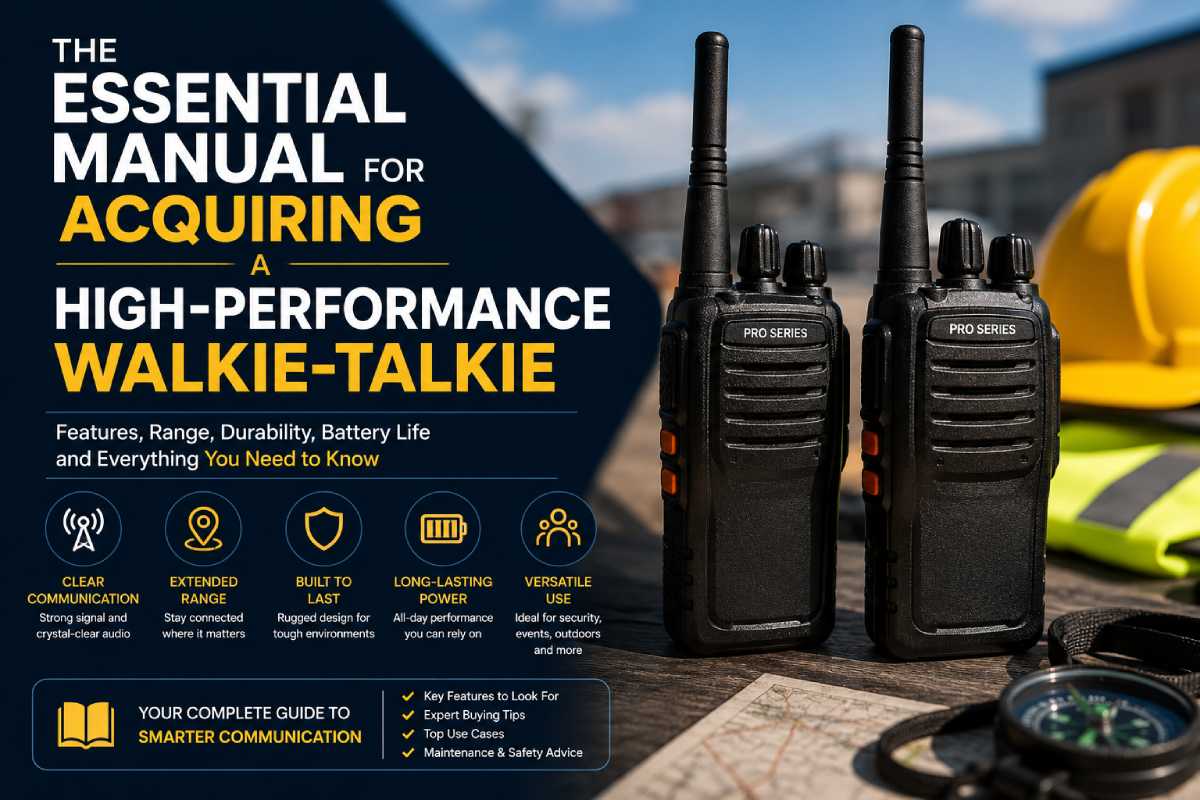
The Essential Manual for Acquiring a High-Performance Walkie-Talkie
Buying a walkie-talkie used to be simple.
You grabbed a plastic pair from a sporting goods store, tested them across the backyard, yelled “Do you copy?” exactly three times, and called it a day.
Then modern communication technology happened.
Now there are long-range systems, cellular push-to-talk devices, encrypted channels, nationwide coverage options, rugged emergency models, weather-resistant builds, rechargeable batteries, and enough technical terminology to make someone accidentally open twelve comparison tabs at midnight.
Suddenly, buying a walkie-talkie feels less like shopping and more like preparing for a satellite launch.
But the reality is simpler than it looks.
Most people don’t need the most advanced communication system on earth. They need something reliable, practical, and durable enough to function when smartphones become inconvenient, or completely useless.
And increasingly, that situation happens more often than people expect.
This is where most buyers get distracted immediately.
People start shopping for a walkie-talkie and suddenly convince themselves they require military-grade communication technology capable of surviving volcanic activity.
Maybe. But probably not.
The better question is: What will you actually use it for?
Different users need different features:
The ideal device depends entirely on usage.
Someone coordinating a weekend camping trip has very different communication needs than a team managing large outdoor events across multiple locations.
Obvious statement. Frequently ignored.
This is one of the biggest misconceptions in the walkie-talkie market.
Traditional radios often advertise impressive range numbers, but real-world conditions dramatically affect performance. Mountains, buildings, trees, weather conditions, and urban environments all interfere with radio signals.
That’s why many modern systems now use cellular infrastructure instead of relying solely on traditional radio frequencies.
A nationwide push-to-talk walkie-talkie operating over cellular networks can communicate over much longer distances as long as coverage is available. That’s a major upgrade from older systems, where stepping behind a hill sometimes transformed conversations into static-filled guessing games.
Consumers should understand the difference between:
Because they solve very different problems.
Modern consumers are exhausted by devices demanding constant charging.
Smartphones already dominate that category aggressively enough.
A high-performance walkie-talkie should prioritize reliability and battery efficiency over unnecessary distractions. Long battery life becomes especially important during:
According to the Federal Communications Commission, reliable communication systems remain essential during emergencies and infrastructure disruptions. Devices designed specifically for communication often outperform smartphones in those scenarios simply because they’re built around one core function.
Communication. Not endless multitasking.
A good walkie-talkie should survive real life.
That sounds obvious, yet plenty of communication devices seem designed for people who exclusively operate indoors beside climate-controlled coffee shops.
If you’re investing in a long-term communication tool, durability matters:
Because eventually someone will drop it.[Text Wrapping Break]Usually immediately after saying, “Be careful with that.”
Technology companies love complexity.
Consumers usually do not.
One of the biggest advantages of a modern walkie-talkie is immediate communication. Press the button. Speak. Message delivered. No unlocking screens, switching apps, or wondering whether someone ignored a text notification three hours ago.
Simple systems reduce friction.
And during stressful situations, simplicity becomes incredibly valuable.
Especially when communication actually matters.
Consumers exploring long-range communication systems and modern push-to-talk technology can learn more through resources focused on nationwide communication reliability and accessibility.
The resurgence of the walkie-talkie isn’t nostalgia.
It’s practicality.
Recent years have changed how people think about communication reliability. Severe weather, overloaded mobile networks, remote travel, and infrastructure disruptions reminded consumers that smartphones are powerful, but not perfect.
A dedicated communication device offers something increasingly valuable:[Text Wrapping Break]Focused reliability.
No social media distractions. No app overload. and no endless notifications fighting for attention.
Just communication.
And honestly, in 2026, that simplicity feels almost luxurious.

Syed Sadiq is a health education content researcher who writes evidence-informed guides on symptoms awareness, preventive health habits, and digital safety topics affecting students and families. His articles focus on helping readers understand health-related information clearly before making decisions. Through DionHealthWeb, he publishes structured health-awareness content designed to support informed conversations between readers and healthcare professionals.