


Charlie Health – Mental health care has changed dramatically in recent years.
With the rise of online therapy platforms, many people are turning to virtual treatment programs instead of traditional in-person care.
One name that’s getting a lot of attention is Charlie Health.
But what exactly is it?
Is it legitimate?
Does it actually work?
And more importantly, is it right for you or your family?
This guide breaks everything down in a clear, medical-style, evidence-backed way so you can make an informed decision.
Charlie Health is a virtual behavioral healthcare provider that offers intensive outpatient mental health treatment through online platforms.
It focuses on:
The company primarily serves:
Their goal is to provide accessible, personalized, and intensive therapy from home.
An intensive outpatient program (IOP) is a structured, non-residential treatment model that combines group therapy, individual therapy, and family support for mental health and substance use conditions without requiring hospitalization. Learn more about how intensive outpatient programs work
Unlike traditional therapy (once a week), Charlie Health offers a more structured approach.
Core treatment model:
Patients typically attend:
Charlie Health is designed for people who need more support than standard therapy, but not full hospitalization.
Key features:
Charlie Health is usually recommended for:
It is particularly focused on high-risk individuals who need structured care.
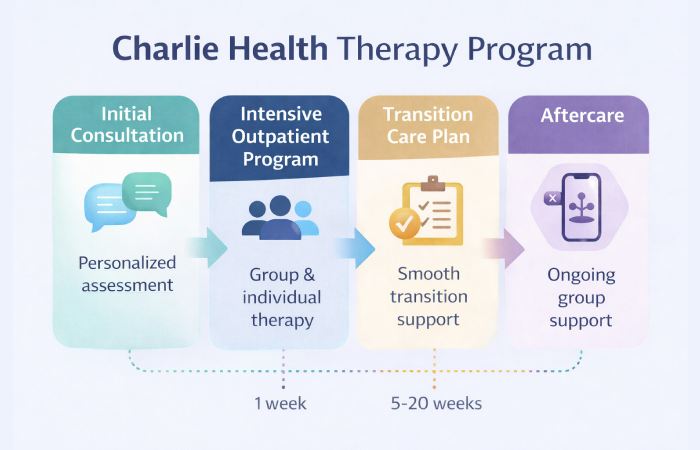
This is the core service.
Includes:
Patients get:
Important for:
Charlie Health focuses on multiple mental health conditions.
Common conditions treated:
Their programs are evidence-based and personalized for each patient.
No travel needed — all sessions are online.
Unlike casual therapy:
Includes:
Programs are built using:
According to internal data:
👉 These are strong indicators, but results vary by individual.
Independent clinical studies on virtual intensive outpatient programs have shown significant reductions in depression, suicidal ideation, and self-harm symptoms among participants, supporting the effectiveness of structured remote mental health care. Peer-reviewed study on virtual IOP outcomes
To give a balanced and trustworthy view, let’s look at concerns reported by users.
Some users report:
Because it’s a large network:
3-hour sessions multiple times a week can be:
Virtual care may not work well for:
Positive experiences:
Negative feedback:
👉 This is common across most large therapy platforms.
Pricing depends on:
Important point:
Charlie Health often works with insurance providers, meaning:
👉 Always confirm costs BEFORE enrolling.
| Feature | Charlie Health | Traditional Therapy |
| Frequency | 3–5 times/week | 1 time/week |
| Format | Online | In-person |
| Intensity | High | Moderate |
| Cost | Insurance-based | Variable |
| Support | Group + individual | Mostly individual |
You may benefit if:
Avoid or reconsider if:
Not checking insurance coverage
Ignoring program intensity
Expecting instant results
Not committing to sessions
Charlie Health is not a replacement for emergency care.
If you are experiencing:
👉 Seek immediate medical help or emergency services.
Is Charlie Health legit?
Yes, it is a registered mental health provider offering structured online therapy programs.
How long is the program?
Typically several weeks depending on the patient’s needs.
Is it covered by insurance?
Often yes, but coverage varies.
Is it suitable for teenagers?
Yes — it has specialized programs for teens.
Does it replace therapy?
No — it is a more intensive form of therapy, not a replacement.
Charlie Health represents a new generation of mental healthcare — accessible, structured, and technology-driven. While it offers strong benefits for those needing intensive support, it’s not a one-size-fits-all solution. Understanding how Charlie Health works, its benefits, and its limitations can help you decide whether it’s the right step toward better mental health.